 | | | Tue, Nov. 3 · Election Day | 78°, sunny |
| | Election Day Special Polls close at 8 p.m. In line by 8, you vote. |
| Today in ten seconds ▸ Sunny, with a high near 78. Go today. ▸ Mail ballot still on the counter? It has to be Downtown by 8. ▸ Governor tops the ballot. There’s a county question too. ▸ And six moments from Pittsburgh’s voting history. |
| This is a bonus issue. No market numbers, no house. Thursday’s regular issue still comes. Today there’s one job, and you have until 8 o’clock to do it. | Go Vote | Everything You Need Before 8 p.m. • When: polls are open 7 a.m. to 8 p.m. If you’re in line at 8, they have to let you vote. Don’t leave the line. • Where: check your polling place before you go, even if you’ve voted there for years. About 50 polling places in Allegheny County moved this fall, several in Bethel Park alone. One moved yesterday: the Westinghouse Park location (Ward 14, District 13) closed for structural problems, and those voters go to the Homewood branch of the Carnegie Library instead. • ID: only if it’s your first time voting at that polling place. A driver’s license or passport works. So does a utility bill or bank statement with your name and address on it. • Mail ballot still on the counter? It has to be in the county’s hands by 8 p.m. Postmarks don’t count, and you can’t drop it off at your polling place. Today, take it to the County Office Building, 542 Forbes Ave. Downtown, Ross Street entrance, until 8 p.m. Your own ballot only. Or take the whole packet, the blank ballot and its return envelope, to your polling place. Hand it over, sign a form, and you vote a regular ballot like everyone else. Show up without it and you’ll vote a provisional ballot. • Problem at the polls? Call the county elections division at 412-350-4500. • Weather: sunny, with a high near 78, the National Weather Service says. Rain holds off until Wednesday night. A good day to stand in a line. • Tonight: county results post here after 8. Pennsylvania doesn’t let counties open mail ballots until 7 a.m. on Election Day, so a close race might not be called tonight. | What’s on Your Ballot Your ballot depends on where you live. WESA’s voter guide covers the contested races around here. The short version: • Governor is the only statewide race. Democratic Gov. Josh Shapiro and Lt. Gov. Austin Davis face Republican state Treasurer Stacy Garrity and her running mate, Jason Richey. Libertarian Ken Krawchuk is on the ballot too. • U.S. House: Summer Lee vs. James Hayes in the 12th. Chris Deluzio vs. Beaver County Sheriff Tony Guy in the 17th. Guy Reschenthaler vs. Alan Bradstock in the 14th. Mike Kelly vs. Justin Wagner in the 16th. • Harrisburg: all 203 state House seats are up, and Democrats hold the chamber 103 to 100. Half the state Senate is up too. Around here that includes Lindsey Williams vs. Thomas West in the 38th. The county question, the one people skip. County Council’s 15 members are part-time and paid about $11,000 a year. The county charter bans them from getting personal staff, district offices or benefits on the county’s dime. A yes deletes that ban. Council would still have to pass separate bills to actually give itself any of it. A no keeps the ban. Either way, council’s budget stays capped. WESA walks through it.Not on it: county term limits. A judge struck that question. And there are no statewide ballot questions this year. | | Six Moments in Pittsburgh Voting History |  The Pennsylvania College for Women float (that’s Chatham now) in Pittsburgh’s suffrage parade, May 2, 1914. Public domain. | Before you go stand in line, a little history. Six moments from the last 188 years. | 1838Pennsylvania Writes “White” Into the Vote Pennsylvania’s old constitution gave the vote to “freemen” and didn’t mention race. The new one, ratified in October 1838, limited it to “white freemen.” Black Pittsburghers fought it with a document called the Pittsburgh Memorial, arguing that free Black men should keep the right to vote. Lewis Woodson, a barber, minister and educator, was secretary of the group behind it. They lost. Black men in Pennsylvania didn’t get the vote back until the 15th Amendment in 1870. One study of the convention found that delegates from counties with larger shares of Black residents tended to vote against taking it away. | 1903“Pittsburg: A City Ashamed” In the last two decades of the 1800s, a Republican machine run by Christopher Magee and William Flinn controlled Pittsburgh. From 1887 to 1896, Flinn’s firm got nearly all of the city’s paving contracts. In May 1903, two years after Magee died, the muckraker Lincoln Steffens laid it out in McClure’s magazine under that headline: “Magee wanted power, Flinn wealth.” It became a chapter of his book The Shame of the Cities, and you can still read it free. About that missing “h”: from 1891 to 1911, the federal government spelled the city’s name without it. | 1915The Pirates’ Manager Endorses Woman Suffrage Only men got to vote on giving women the vote. So the yes campaign went after baseball fans. This flier pointed out that Pirates manager Fred Clarke “comes from Kansas, where women vote,” and quoted him: woman suffrage “has a good batting average and mighty few marks in the error column.” | 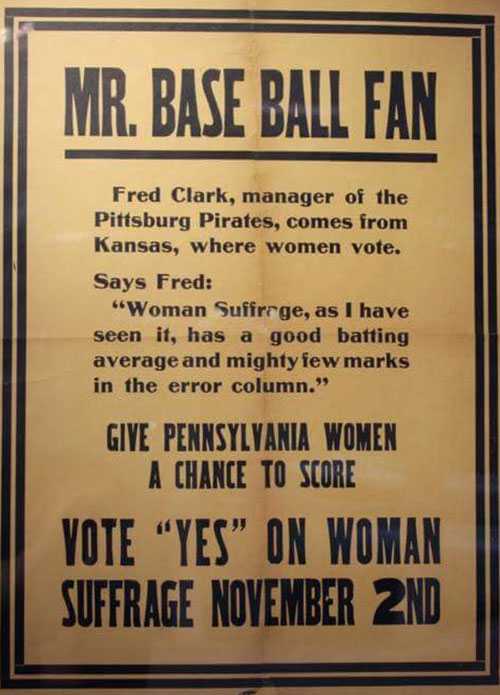 “Give Pennsylvania women a chance to score.” Pittsburgh, 1915. Public domain. | Allegheny County voted yes, 51.5%. The state said no by about 55,700 votes. Philadelphia alone voted it down by 45,000. Women here had to wait for the 19th Amendment. The Post-Gazette has the whole story of Pittsburgh’s suffrage fight. | 1920KDKA Puts the Returns on the Air On Nov. 2, 1920, at 6 p.m., Westinghouse’s station KDKA went on the air from a makeshift shack on top of one of its buildings in East Pittsburgh. The Pittsburgh Post phoned in the Harding–Cox returns, and an estimated 1,000 people listened. It’s widely credited as the first commercial radio broadcast. It was also the first presidential election after the 19th Amendment. |  Smithsonian aide Fred C. Reed with the “tomato can” microphone KDKA used for the 1920 returns, 1938. Photo: Harris & Ewing, Library of Congress. | 1932“Turn the Picture of Lincoln to the Wall” Since the Civil War, most Black voters had stuck with the party of Lincoln. In 1932, Robert L. Vann, editor of the Pittsburgh Courier, told them it was time to turn Lincoln’s picture to the wall and vote for Franklin Roosevelt. Under Vann, the Courier became the country’s biggest Black weekly, at about 250,000 copies. His state historical marker stands at Centre Avenue and Frances Street. The switch took a few years. Hoover still won most Black neighborhoods in 1932. By 1936, Gallup found about three in four Black voters in the North went for Roosevelt. | 1933The City Flips Republican Mayor Charles Kline resigned in 1933 after a malfeasance conviction. That November, Democrat William McNair beat Republican John Herron by 23,419 votes, the first Democrat to win the job since 1905. Pittsburgh hasn’t had a Republican mayor since Herron left office. That’s more than 90 years. | People here fought for the vote, lost it, waited decades for it, and used it to flip a city. Today it’s your turn, and it’s sunny and near 78. Go. Then hit reply and tell me how long your line was. |
| Meanwhile, in the neighborhood group chat Did you see what houses on our street are going for?? No. How much?? It’s in the Housing Brief 👀 Be the neighbor who knows. The Pittsburgh Housing Brief is my other newsletter. Once a month: what sold, what sat, and what it means for your street. Only real estate, from the guy who sells it. Free. No form. One tap and you’re on the list. |
|  | Meet the Writer Hi, I’m Tim. |
I grew up in Lower Burrell and did the reverse migration to the city when my wife went to law school here. We lived in Bloomfield for years, and now we’re in Lawrenceville. I’m passionate about Pittsburgh and our future here. I love writing about what’s happening: the fun events, the people, and even the stuff that goes unnoticed. And yes, selling homes is my day job. When you or somebody you know is ready to buy or sell, I’d love to be the call. |
| | — Tim |
|